ADVERTISER

22 Ekim 2017 Pazar

Vietnam Travel Guide Vietnam Lonely Planet

You’ve probably seen it in the background of countless war movies, but nothing can prepare you for the epic beauty of Vietnam. While it isn’t my favorite country in the world, it is very beautiful and there is no denying that. From the natural beauty of Sam Mountain and Halong Bay to the manmade artistry of the sacred temples and pagodas, to the rice terraces and beaches, Vietnam has a lot to offer travelers.

Vietnam has suffered a long dark history of colonialism, communism, war, and poverty. Recently, the tourist industry is growing and has become a major source of national revenue for the past 10-15 years. You cannot escape learning about the horrid history whose effects are still visible on the faces, bodies the locals even today. Like India, many travelers either love or hate it here. Admittedly, it’s a hard country to travel through, but despite the challenges, you will find a very interesting and visually-pleasing place to visit.

Typical Costs
Accommodation – Hostels start at 130,000 VND per night. Private rooms average about 390,000 VND for a double room. In the past hostels were pretty scarce, though recently, hostels have started popping up all over the country to accommodate budget travelers.  “Homestays” are often popular budget option, too.

Food – By eating at street stalls and markets you can get a bowl of pho or a rice dish for 20,000 VND. Most sit down restaurants are also inexpensive at around 40,000–90,000 VND.  The fancier (and more touristy) the restaurant, the more expensive.  A liter of water at a convenience store is about 15,000 VND, while a beer or soda at a restaurant is about 20,000-35,000 VND.

Transportation – Bus travel is very cheap in Vietnam.  For example, the public bus around Ho Chi Minh City will cost a maximum of 3,500 VND.  The train is also another inexpensive way to travel with the 791km long train journey from Da Nang to Hanoi costing 750,000 VND. Overnight buses (aside from saving on a night’s accommodation) are only about 100,000-500,000 VND and can take you to lots of cities in Vietnam.  There are extremely low-cost airlines that can hop you around the country quickly for as little as 400,000 VND.

Activities – Many of Vietnam’s attractions are based around its natural beauty and as such, cost very little. For organized excursions such as touring the Cu Chi Tunnels you can expect to pay between 100,000–200,000 VND.  Halong Bay tours from Hanoi start at 650,000 VND for two-day trips and increase exponentially from there. Half-day cooking classes and bicycle tours are heavily targeted at tourists, so they cost a bit more, and start at about 300,000 VND.

Money Saving Tips
Eat delicious street food – The food is usually excellent, really cheap and you can watch it being cooked in front of you. Stick to the local food and you’ll save money. The street-side pho, bread, meat sandwiches (called bahn mi), donuts, and bananas are your best deals all of which can be found around 20,000 VND on the streets.

Late-night travel – If traveling long journeys, try to take the late night “sleeper” buses or trains as this will save you the cost of a night’s accommodation.  Depending on the company, you may even have a chance to comfortably lie flat as you ride through the dark countryside to your next destination.

Take the tourist bus – It is actually cheaper to take the tourist bus around the country than taking local transportation because of the “tourist” price you get at the bus station.

Don’t be afraid of taxis – Metered taxis in this country are affordable.  If you are moving around town at night, this is a good, safe, cheap option (especially if you’re splitting the cost with a few others).  A 30-minute ride will set you back around 130,000 VND. The best taxi companies are Mai Linh and Vinasun.

Fly for cheap – Vietnam’s low-cost airlines: VietJet and FlyVietnam are extremely inexpensive and adding luggage to your flight can cost as little s 120,000 VND.  This is a great option for people with limited time to explore different regions of Vietnam.

Bargain hard – Tourists tend to be charged more than locals for everything from cycles (a three-wheel bicycle taxi) to clothes to street food. Bargain harder than you would ordinarily, and don’t underestimate the value of walking away.

Skip the SIM Card – Vietnam is highly connected to Wi-Fi.  You can hook into Wi-Fi in just about every hotel, shop, restaurant, and convenience store for free! Unless you need to have connectivity during long bus rides or rural areas, I’d forgo the SIM card and take a break from connectivity.

Ask your hostel staff – Before you leave the hostel, ask them to estimate how much what you want to do should cost. How much should a ride to the museum cost?  How much should I pay to have a gown like this made? They will be able to give you bargaining guidelines.

Stay a while – You’ll hear tales from many backpackers who have been to many different Vietnamese regions on a very short trip.  A good way to save money and savor the experience is to slow down. Divide your time between a few spots and enjoy.

Factor in visa fees – Visiting Vietnam comes with a much higher visa fees than the surrounding Southeast Asian countries.  Look up the visa requirements and fees before you arrive. Better to be safe than sorry!

Top Things to See and Do in Vietnam
Admire the pagodas – Vietnam’s most distinctive architecture can be been in the pagodas, which can be found all over the country. They are known for their beautifully intricate carvings. Pagodas are used as shrines and temples and are treasured by the Vietnamese people.

Wander around Hanoi – Vietnam’s capital, Hanoi handsomely combines French colonialism with Eastern influences.  Enjoy an afternoon exploring the narrow streets of the Old Quarter or visit the countless temples and galleries dotted around this bustling city.  Don’t miss the History Museum which showcases artifacts from Vietnam’s colorful history and the Ho Chi Minh City Mausoleum. Hanoi is also a good base for doing multi-day tours to Halong Bay, Hua Lu and Tam Coc.

Relax or find adventure in Dalat – Dalat is nestled in the hills of the Central Highlands and is popular with tourists who want to relax in the mountain air, so people flock here for serenity. Others go to Dalat to participate in a host of adventure sports that happen within a naturally beautiful backdrop.  The hills around Dalat are filled with traditional tribal villages, which you can tour, but there is plenty to do within the city itself too.  Visit the imaginatively titled palaces: Palace I, Palace II and Palace III.

Tour the Mekong Delta – The delta is a 60,000km long web of interconnected waterways, which span across three Vietnamese provinces.  The area is filled with small craft villages, Khmer Pagodas, mangroves, orchards and the trademark floating markets.  The best way to experience Delta life is to go on one of the many boat or bike tours. Spend a few days exploring the stunning region.

Crawl through the Cu Chi Tunnels – Crawl through the extensive network of nearly 500 km of tunnels utilized by the Viet Cong in the war with the USA in the 1960s.  Tours involve a description of the tunnels, after which tourists are allowed to crawl about the maze and fire AK47s at shooting targets. It’s a sobering experience and not one meant for anyone claustrophobic. However, if you want a better understand the terror of the Vietnam War, this is a must-visit. Enter for about 100,000 VND.

Visit Cuc Phuong National Park – About 120km southwest of Hanoi lies Vietnam’s first National Park, Cuc Phuong. Covering 222 sq km, this place is home to over 2,000 species of trees and some truly rare wildlife including the Clouded Leopard, Delacour’s Langur and Owston’s Civet. It was my favorite park in all of Vietnam and the only place I didn’t find hordes of tourists. The entrance fee is 40,000 VND.

Hang out in Hoi An – Hoi An is one of the most popular destinations for tourists traveling to the country.  The place is packed with historical homes and buildings and quaint cafes.  It’s small and great for walking, buying suits (they have a huge fashion and tailor market), eating, nearby beaches, and relaxing by the river. It was easily my favorite place in Vietnam. It’s not unusual to find backpackers using Noi An as a resting ground while they recharge from constant traveling.  This is a relaxing quality to it that makes staying for a while very attractive.

Explore Ho Chi Minh City – Also known as Saigon, Ho Chi Minh City is Vietnam’s largest city and is definitely worth exploring.  Like most cities in Vietnam, you’ll be met with the roar of motorbikes speeding through colonial streets.  Ben Thanh market is a must-see for amazing food and there is a great buzz of activity within the place. If flying into the SGN airport, it’s worth spending a day or two exploring the city.  I recommend spending the night at The Common Room Project for a great hostel experience.

Hike in Halong Bay – More than 3,000 islands sit within the emerald green waters of Halong Bay, one of the country’s most popular tourist destinations. Cat Ba Island has great for hiking and many tourists find themselves taking one of the cave tours. Tours here usually leave from Hanoi and last 3 or 5 days. Try to find a good operator as many oversell or lie about what their boats look like (ask for advice from your hotel staff or travelers who have just returned for the trip).

Get active in Mui Ne – Despite being a fishing village, Mui Ne has got a significant tourism scene, due to its popularity as a wind- and kite-surfing destination, and the rolling sand dunes that lie nearby.

See My Son – My Son is a set of Hindu ruins in Vietnam which date back to the Cham Empire. The Champas ruled over Central Vietnam from the 3rd to the 19th century. The temples here are of incredible historical importance, but they have been largely reclaimed by the surrounding jungle, and have fallen into a great state of disrepair. Don’t come here expecting something as marvelously preserved as Borobudur or Angkor Wat. Entrance fee is 100,000 VND for foreigners.

Visit the caves in Phong Nha-Ke Bang – Hang Son Doong is reputed to be the world’s largest cave, and is located in Phong Nha-Ke Bang National Park. It was discovered by a local in 1990, and “rediscovered” by a British caving team in 2009. You can arrange trips to see this stunning cave. You’ll be blown away by its beauty.

Dive in Nha Trang – This area is full of seaside resorts, and has a distinct urban feel. However, the beautiful sand and clear water make it a main spot for scuba diving in Vietnam.

Check out the rice terraces – Outside of connections to the Vietnam War, the stereotypical image of Vietnam is of the many rice paddies. You can find these in the Muong Hoa Valley.  If you’ve never visited rice terraces, you should make a point to see them in Vietnam.  Visit them to learn about rice production and take stunning photographs of the unbelievable Vietnamese countryside.

India Travel Guide Expert Picks for your India Vacation

From the soaring snow-dusted peaks of the northern mountains to the sultry sun-washed beaches of the southern coast, India's dramatic terrain is breathtaking. Along with abundant natural beauties, exquisitely carved temples rise majestically out of pancake-flat deserts and crumbling old fortresses peer over plunging ravines. Aficionados of the great outdoors can scout for big jungle cats on wildlife safaris, paddle in the shimmering waters of one of many beautiful beaches, take blood-pumping treks high in the Himalaya, or simply inhale pine-scented air on meditative forest walks.Spirituality is the common characteristic painted across the vast and varied canvas that is contemporary India.

The multitude of sacred sites and rituals are testament to the country's long, colourful, and sometimes tumultuous, religious history. And then there are the festivals! India hosts some of the world's most dazzling devotional celebrations – from formidable city parades celebrating auspicious events on the religious calendar to simple harvest fairs that pay homage to a locally worshipped deity.

A spending spree in Mumbai's designer shops and a stay in an international hotel in Delhi is going to cost you as much as it would in Dubai, but away from these enclaves the cost of living is ridiculously low. Even if you travel first class on the trains (the Rajdhani or the Shatabdi Express are the most comfortable to travel on, being fully air-conditioned with meals included in the ticket price) and take taxis everywhere, you’ll be hard pressed to spend a lot of money here and it's possible to live like a raj on just £15 (about 1,500 rupees) a day. India is the seventh largest country in the world, so unless you're planning an incredible six month sojourn, it pays to plan which of the country's 29 states you want to visit.

Head to western India to Rajasthan for an assault of the senses in the state capital, the Pink City, Jaipur, or kick back on the white sands of Kerala in southern India. You can't fly all that way without seeing what may well be the most famous tomb in the world, the Taj Mahal, in Agra, northern India - just don't go on a Friday, it's closed. And don't worry about Delhi belly, you'll find some of India's best street food here in the capital, particularly in the narrow streets and bustling boulevards around Connaught Place in the centre of town. Pick your stall wisely - make sure they look clean and if they're busy it usually means the food is fresh, but it's still a good idea to pack the Immodium, just in case.

India, it is often said, is not a country, but a continent. Stretching from the frozen summits of the Himalayas to the tropical greenery of Kerala, its expansive borders encompass an incomparable range of landscapes, cultures and people. Walk the streets of any Indian city and you’ll rub shoulders with representatives of several of the world’s great faiths, a multitude of castes and outcastes, fair-skinned, turbanned Punjabis and dark-skinned Tamils. You’ll also encounter temple rituals that have been performed since the time of the Egyptian Pharaohs, onion-domed mosques erected centuries before the Taj Mahal was ever dreamt of, and quirky echoes of the British Raj on virtually every corner.

That so much of India’s past remains discernible today is all the more astonishing given the pace of change since Independence in 1947. Spurred by the free-market reforms of the early 1990s, the economic revolution started by Rajiv Gandhi has transformed the country with new consumer goods, technologies and ways of life. Today the land where the Buddha lived and taught, and whose religious festivals are as old as the rivers that sustain them, is the second largest producer of computer software in the world, with its own satellites and nuclear weapons.

However, the presence in even the most far-flung market towns of internet cafés, smart phones and Tata Nano cars has thrown into sharp relief the problems that have bedevilled India since long before it became the world’s largest secular democracy. Poverty remains a harsh fact of life for around forty percent of India’s inhabitants; no other nation on earth has slum settlements on the scale of those in Delhi, Mumbai and Kolkata (Calcutta), nor so many malnourished children, uneducated women and homes without access to clean water and waste disposal.

Many first-time visitors find themselves unable to see past such glaring disparities. Others come expecting a timeless ascetic wonderland and are surprised to encounter one of the most materialistic societies on the planet. Still more find themselves intimidated by what may seem, initially, an incomprehensible and bewildering continent. But for all its jarring juxtapositions, intractable paradoxes and frustrations,

India remains an utterly compelling destination. Intricate and worn, its distinctive patina – the stream of life in its crowded bazaars, the ubiquitous filmi music, the pungent melange of diesel fumes, cooking spices, dust and dung smoke – casts a spell that few forget from the moment they step off a plane. Love it or hate it – and most travellers oscillate between the two – India will shift the way you see the world.

SOURCE: https://www.roughguides.com/destinations/asia/india/

16 Eylül 2017 Cumartesi

Charter Yacht Annaliesse

Mega motor yacht ANNALIESSE built in 2004 is one of the world's most impressive charter yachts, spectacular at every level, built to SOLAS safety specifications, with exceptional taste in design by Lalis Poulias. Construction is by steel in hull and superstructure with aluminium deckhouses. The mega motor yacht is equipped to carry op to 36 passengers with 34 crew members. With a range of over 7.000 nautical miles, Annaliesse is capable of crossing the Atlantic, navigating the Panama Canal and reaching the west coast of the United States and Mexico, while spends summer time in Mediterranean Sea. She has unquestionable presence with her sleek hull, at the same time towering but welcoming. Access is easy via passarelle or the wide, teak swimming platform and once on board, life unfolds over five spectacular decks.

Thirty six guests are looked after by thirty-four crew and there is room to entertain at the most lavish level. With 2.400 square meters (25.833 sq. ft.) of guest space, everyone can enjoy the Annaliesse of their choice. And the choice is enormous. Arriving by lift 21 meters (70 ft.) up from the sea, the sun deck provides privacy, intimacy and spectacular views over your domain. At the one end, the heli-pad converts into a circular sunbathing terrace, at the other, is a jacuzzi surrounded by sunbeds. Crew at the large bar serve anything from a cold drink to a hot buffet-24 hours a day. For sport, there are four waverunners, two tenders and a garage full of other leisure equipment including a fully equipped diving centre. At night the bridge deck is tranformed- dimmed lights overhead, candle lights on starched white table linen and dinner as only Annaliesse can provide!

Charter Yacht Haida G

Ex RosenKavalier, the Haida G mega yacht is the greatest surviving classic motor yacht of the 1920's at no exaggeration. Designed by Cox & Stevens and built by the Friedrich Krupp Shipyard in Kiel Germany, she is still powered by her original Krupp Diesel engines. A great history stars from her first owner the millionaire Max Fleischman of Santa Barbara with her first name HAIDA . Decades later the yacht is on her initial name and tenth owner. During World II Haida was acquired by the US Navy in October 1940 and was converted for coastal patrol. Named as Sarina by the following owner in Egypt remained in Alexandria until King Farouk was overthrown, at which time Adda Maurice the owner based her in Cannes for use as a floating home and office.

Mexico Country Specific Information

Mexico is a Spanish-speaking country about three times the size of Texas, consisting of 31 states and one federal district. The capital is Mexico City. Mexico has a rapidly developing economy, ranked by the International Monetary Fund as the fourteenth largest in the world. The climate ranges from tropical to arid, and the terrain consists of coastal lowlands, central high plateaus, deserts and mountains of up to 18,000 feet.Many cities throughout Mexico are popular tourist destinations for U.S. citizens. Travelers should note that location-specific information contained below is not confined solely to those cities, but can reflect conditions throughout Mexico. Although the majority of visitors to Mexico thoroughly enjoy their stay, a small number experience difficulties and serious inconveniences.

LARGEST yachts with library and marble Jacuzzi on sale for $53 MILLION

A SUPER YACHT boasting a library and a marble jacuzzi has gone on the market for a whopping $53 million (£43.3 million).
Athena is believed to be the fourth largest sailing yacht in the world - and currently the only one in this size range up for sale.

The three-storey, 295ft long vessel was built in 2004 at the Royal Huisman Shipyard in the Netherlands.

In 2011 it underwent a revamp and is now being sold by boat dealer Burgess.

It is ideal for yachting enthusiasts and can sleep up to 10 people in the five cabins, one of which is a master suite.

The master suite has its own study, walk-in-wardrobe and Jacuzzi.

The yacht can also house 21 members of staff.

Guests can enjoy sunbathing on the outdoor lounges and working out in the onboard gym.

Across this luxurious ship's three levels there are a variety of saloons.

The world's largest cruise ship, which is almost 165 feet longer than the Eiffel Tower, has set off on its first sea trial from France. Harmony of the Seas, which cost almost £800million to build and weighs 227,000 tonnes.These include a bridge deck, media room and a large main saloon that leads to a stunning dining room.

There is also another table on the vast deck so everyone can enjoy a spot of al fresco dining.

Plus there's another study area with floor to ceiling bookshelves and plenty of storage space.

This impressive yacht has been decked out in lavish mahogany wood and teak and finished with fine furnishings. Athena also boasts impressive technology with its Panamax masts rigged with 2,500 square metres of sail power. And the hydraulically hoisted crow’s nest, which sits at 190ft high, offers panoramic views.

Its twin 3156B Caterpillar engine means this boat can cruise at a range of 4,000 nautical miles at 10 knots. Although this vessel is currently sitting in the Caribbean sporting a Cayman Islands flay, it must be sold offshore and out of US waters. The story comes after a new capsule hotel could see visitors waking up on a desert island.

http://www.express.co.uk/travel/articles/776268/yacht-worlds-largest-for-sale

Giverny and Versailles Small Group Day Trip from Paris

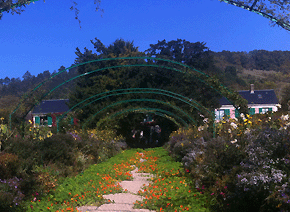
After picking you up at the doorstep of your downtown hotel in Paris, our guide will take you for a wonderful day outside of Paris.This day will lead you first to the edge of Normandy, where you will visit Claude Monet's home, the "Father of Impressionism". There you will discover the famous gardens created by the impressionist painter, and the well known Japanese bridge in the midst of its flowered paths and wather-lily ponds.

"Claude Monet's property at Giverny, left by his son to the Académie des Beaux-arts in 1966, has, after completion of large scale restoration work, become the Claude Monet Foundation, inaugurated in 1980. The house, with its pink crushed brick façade, where the leader of the Impressionist School lived from 1883 to 1926, once again has its colourful décor and intimate charin of former times. The precious collection of Japanese engravings is displayed in several rooms, hung in the marmer chosen by the master of Giverny himself.

The huge Nymphéas studio, a stone's throw from the house, has also been restored. It contains the Foundation's Shop. The gardens have been replanted as they once were and offer for the admiration of visitors the "painting from nature" which Claude Monet's contemporaries considered one of his masterpieces. The rectangular Clos Normand, with archways of climbing plants entwined around brilliantly coloured shrubs, lies before the house and studios, offering from Spring to Autumn the palette of varying colours to the painter-gardner who was "ecstatic about flowers". Lastly, the Water Garden, formed by a tributary of the Epte, lies further away, shaded by weeping willows. With its famous Japanese Bridge, its wistarias, azaleas and its pond, it has once more become that casket of sky and water which inspired the pictorial universe of the water lilies."

You will have lunch at the lovely "Moulin de Fourges" restaurant, a 200-year-old mill. The architecture of this listed site, dating back to the 18th century, draws its inspiration from the hamlet of Marie-Antoinette at Versailles. It offers a unique setting with its rural grounds and its spacious terrace on the banks of the Epte.

In the afternoon, you will be driven to Versailles Palace, residence of the Sun King, Louis XIV. There, you will visit on your own Louis XIV's suite, the Hall of Mirrors... An audio guide (included) is available in eight languages (French, English, German, Spanish, Italian, Japanese, Russian and Chinese-Mandarin). You will also have some remaining time to discover the famous "A la Francaise" gardens.

Rodeo Drive Los Angeles Calif

Southern California winters are nothing short of nirvana. Once you get past the fact that Christmas lights hang atop palm trees instead of ...